By Fotini Filinis
•
September 4, 2026
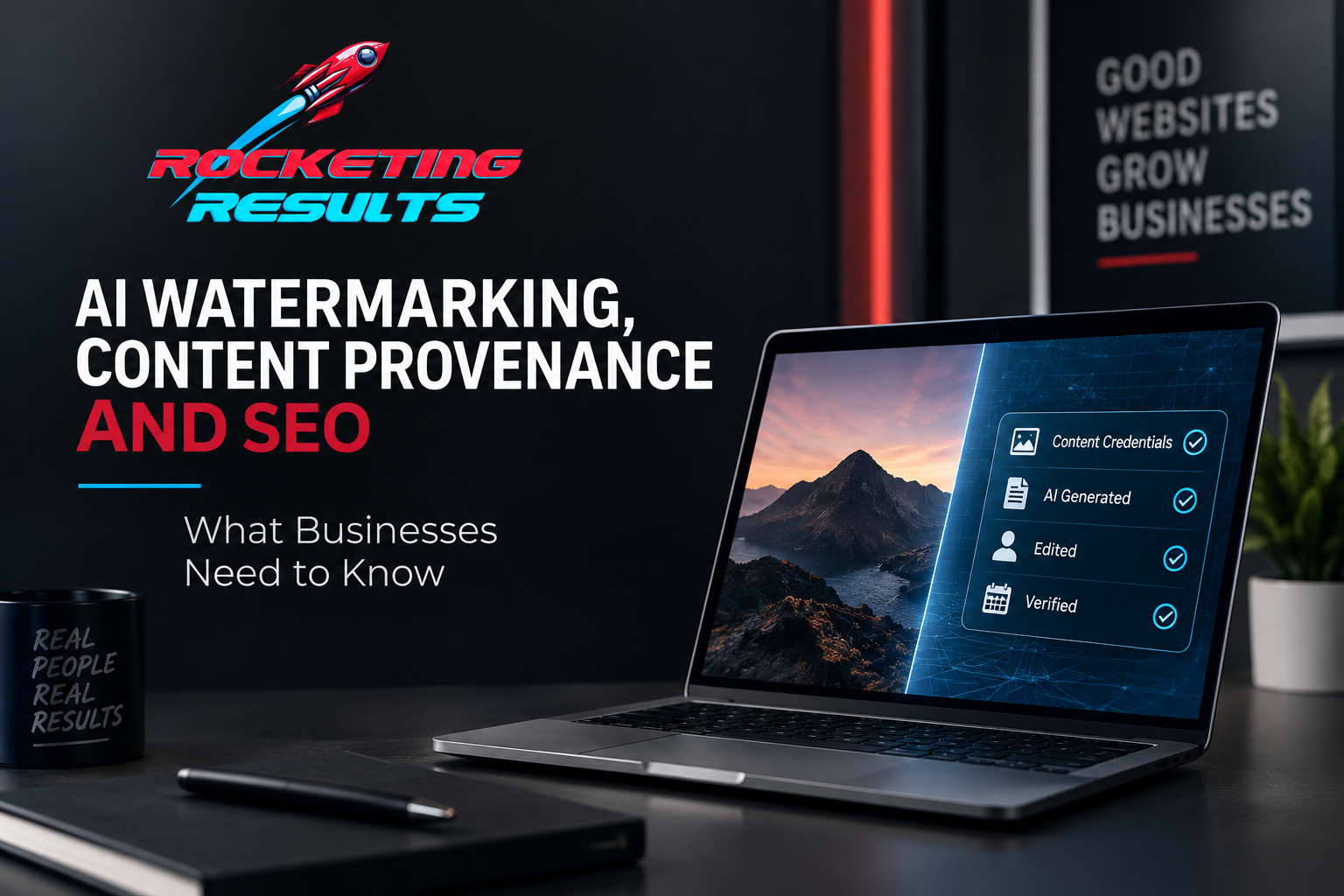
AI is changing how content is created, verified, discovered, and trusted. Here’s what businesses need to understand about AI watermarking, content provenance, and the growing importance of real human expertise in SEO. The key takeaway: AI itself is not the SEO problem. Publishing generic information that adds no original experience, evidence, or expertise is the bigger risk. Businesses that combine AI efficiency with real human knowledge will have a much stronger foundation for both traditional search and AI search. Artificial intelligence has made it possible to research, outline and produce content faster than ever. That has been useful for businesses and marketers, but it has also created a much bigger problem. The internet is filling up with content that looks different but says essentially the same thing. At the same time, technology is getting better at identifying where digital content came from, whether AI was involved and how images, video and other media were created or modified. This is where terms such as AI watermarking and content provenance come in. For business owners, the important question is not whether you should stop using AI. It is whether your content contains enough real knowledge, experience and original information to be worth finding, trusting and citing. What Is AI Watermarking? AI watermarking is a method of embedding information or a detectable signal into content created by artificial intelligence. Depending on the technology, that signal may be contained in metadata or embedded more deeply within an image, video, audio file or generated text. The purpose is generally to provide information about the origin of the content or help identify that AI was involved in creating it. One example is Google’s SynthID technology, which has been developed to identify certain AI-generated media. Another important development is C2PA, or the Coalition for Content Provenance and Authenticity. C2PA supports what are commonly called Content Credentials . Instead of simply labeling something “AI generated,” Content Credentials can provide information about where a piece of digital media originated and how it was edited. Think of it less like a visible watermark across a photograph and more like a digital record attached to the content. What Is Content Provenance? Content provenance is essentially the history of digital content. It can help establish information such as: where content originated what created it whether it was edited what tools were involved whether certain information about its origin can be verified This matters because the internet increasingly has an authenticity problem. Someone can create a realistic photograph of an event that never happened. A company can publish hundreds of articles without anyone at that company having experience with the subject. A website can summarize another ten websites and produce what appears to be a completely new article. Technically, the content may be new. Informationally, it may contribute almost nothing. That distinction is becoming increasingly important for search. Does Google Penalize AI-Generated Content? Not simply because AI was used. Google’s published guidance does not say that content receives a ranking penalty merely because artificial intelligence helped create it. Google says generative AI can be useful for research and for adding structure to original content. The problem is using automation to produce large amounts of content without adding meaningful value. That can fall under Google’s policies concerning scaled content abuse. In other words, the issue is not: Human content good. AI content bad. The better distinction is: Useful, original content versus mass-produced commodity content. That applies whether the person pressing the publish button used ChatGPT, hired a writer or wrote every word personally. Google’s Newer AI Search Guidance Makes the Direction Clear Search itself is also changing. Google Search now includes generative AI experiences that can pull information from multiple websites, synthesize it and present an answer directly to the searcher. That changes what publishers are competing for. Traditionally, the goal of SEO was largely: Get the webpage to rank. That is still important, but another objective is emerging: Create information that search systems consider useful enough to retrieve, reference and potentially cite. Google’s current guidance for appearing in generative AI Search emphasizes creating unique, useful and non-commodity content. That last term matters. Commodity content is information that could come from practically anyone. For example: “5 Reasons You Need an Electrician” “10 Benefits of Local SEO” “7 Signs You Need a New Roof” Those articles are not automatically bad. The problem is that thousands of websites can produce almost identical versions of them. AI makes that dramatically easier. The Real SEO Threat Is Not the AI Watermark Businesses are understandably worried about Google detecting that AI helped create something. I think that concern is focusing on the wrong problem. The much larger SEO risk is publishing content that gives Google or an AI search system no compelling reason to choose your website over another source. Consider two electricians publishing an article about electrical panel problems. The first article says: Flickering lights, tripped breakers and older electrical panels can sometimes indicate electrical problems. Contact a licensed electrician for an inspection. Accurate enough. But thousands of websites already say essentially the same thing. The second electrician explains: A problem he repeatedly encounters in homes built during a certain period. What he discovers when he removes the panel cover. A common repair homeowners attempt before calling him. What he found during an actual service call. Photographs from the job. The circumstances under which he recommends repair versus replacement. Now there is something different. That information originated from experience. AI can help organize that knowledge into an article, but AI did not manufacture the experience. That is the difference businesses need to understand. Human Experience Is Becoming More Valuable, Not Less AI has made average content inexpensive. That means information that cannot easily be generated from existing internet content becomes more valuable. For a local business, some of the best source material already exists inside the owner’s head. A contractor knows: What customers misunderstand. What problems repeatedly appear in homes around the area. Which cheap repairs usually create bigger problems. What customers commonly ask during estimates. What actually affects project pricing. What certain problems look like once the wall, roof, panel or equipment is opened. What happens on jobs that does not match the textbook explanation. That information can become extremely strong search content. The challenge is extracting it. A Better Way to Use AI for SEO Content The old AI content workflow looks something like this: Choose keyword → ask AI for article → edit article → publish That workflow is fast. It also makes it extremely easy to publish the same information everyone else is publishing. A stronger workflow starts somewhere else. Step 1: Capture the Human Source Before writing the article, collect information from the person who actually knows the subject. For a contractor, I might ask: What happened the last time you encountered this problem? What do homeowners usually get wrong? What would make you recommend one solution instead of another? Are there particular homes or properties where you see this more frequently? What should someone never attempt themselves? Can you show me a photograph? What would you tell the homeowner if you were standing in the house with them? Those answers become the raw material. Step 2: Verify the Facts Experience is valuable, but experience and factual accuracy are not always the same thing. Important technical, legal, safety or regulatory claims should still be verified against authoritative sources. AI can assist with research, but it should not be treated as the final authority. Step 3: Use AI for Speed Now AI becomes useful. It can help: Organize the interview. Identify questions the article should answer. Develop headings. Compare the information with common search intent. Create an initial structure. Identify areas that need additional explanation. Improve readability. Generate possible FAQs. The human expertise remains the source. AI becomes the production tool. Step 4: Add Evidence Whenever practical, strengthen the page with evidence. This might include: Original photographs. Screenshots. Examples. Before-and-after situations. Actual customer questions. Owner quotations. Original research. Local observations. Case studies. Data. Supporting sources. This creates something much harder to reproduce. Step 5: Perform a Human Editorial Review Before publishing, someone who understands both the business and the purpose of the article should review it. Ask: Is this accurate? Does this sound like the business? Did we say anything we cannot support? Does this actually teach someone something? Did we contribute information that is not already repeated across hundreds of websites? Would I trust this company more after reading it? If the answers are no, the article is not finished. Write Content Worth Citing There is another question businesses should begin asking. What is in this article that another source would actually want to cite? That question becomes increasingly important as people use Google AI experiences, ChatGPT and other AI systems to research businesses, services and purchasing decisions. An article does not become a good AI-search source because someone added the phrase “AI optimized.” It becomes useful when it contains information worth retrieving. Original statistics are worth citing. First-hand observations can be worth citing. Expert explanations can be worth citing. Detailed case studies can be worth citing. Original research can be worth citing. A rewritten summary of the first ten Google results usually is not. This is also why businesses need to think beyond traditional rankings. In our guide on why your website may not be showing up in AI search , we explain how content structure, authority, clarity, and useful source information can influence whether AI systems can understand and retrieve information from a website. Should Businesses Try to Remove AI Watermarks? I would not make that part of a marketing strategy. Some provenance information can be lost when media is converted, edited or passed through systems that do not preserve metadata. Other technologies are specifically designed to remain detectable after certain modifications. But trying to conceal how content was created solves the wrong problem. Even if every indication of AI involvement disappeared tomorrow, a generic article would still be generic. The stronger strategy is making the content valuable regardless of what production tools were used. If artificial intelligence helped organize a contractor’s real experience into a useful article, the AI assistance is not the interesting part. The contractor’s knowledge is. What Business Owners Should Do Now Businesses do not need to stop using AI. They should stop using AI as a substitute for having something to say. Use it to work faster. Use it to organize information. Use it to find gaps. Use it to assist research. Use it to improve structure. But build important content from information that belongs to the business itself. That could be experience, opinions, data, photographs, projects, processes, customer questions or lessons learned in the field. The more AI-generated information floods the web, the more valuable authentic source material becomes. What This Means for Local SEO For local businesses, this is actually an opportunity. A national publishing company may be able to create 500 articles about plumbing. It cannot recreate what a plumber who has worked inside hundreds of homes in Pinellas County knows about the homes he services. A generic marketing website can publish hundreds of articles about Google Business Profiles. It cannot reproduce the lessons learned from actually managing local businesses, rebuilding websites, diagnosing visibility problems and watching what happens afterward. That is where small businesses can compete. The goal is no longer simply producing more content. The goal is producing information that could only reasonably have come from the business publishing it. AI Should Increase Your Output, Not Replace Your Expertise Artificial intelligence is going to remain part of marketing. Watermarking and provenance technologies will continue developing. Search engines will continue getting better at understanding content. Trying to hide from those developments is a weak long-term strategy. Businesses should be doing the opposite. Create content where the source is obvious. Attach real people to the knowledge. Document experience. Show the work. Support claims. Contribute something original. Then use AI to help communicate that expertise more efficiently. AI can make content faster. Human experience is what can make that content worth finding, trusting and citing. Related Reading: Why Your Website Isn’t Showing Up in AI Search and How to Fix It About the Author Fotini Filinis is the owner of Rocketing Results LLC, where she works directly with small businesses on website design, Local SEO, Google Business Profile optimization, and improving visibility across traditional and AI-driven search. Her work focuses on helping businesses build stronger online visibility with useful content, clear site structure, and real business expertise rather than mass-produced marketing content.