Why Your Website Isn’t Showing Up in AI Search (And How to Fix It)
Learn why Google AI, ChatGPT, Gemini, and other AI search tools may not recommend your website and what you can do to improve visibility.
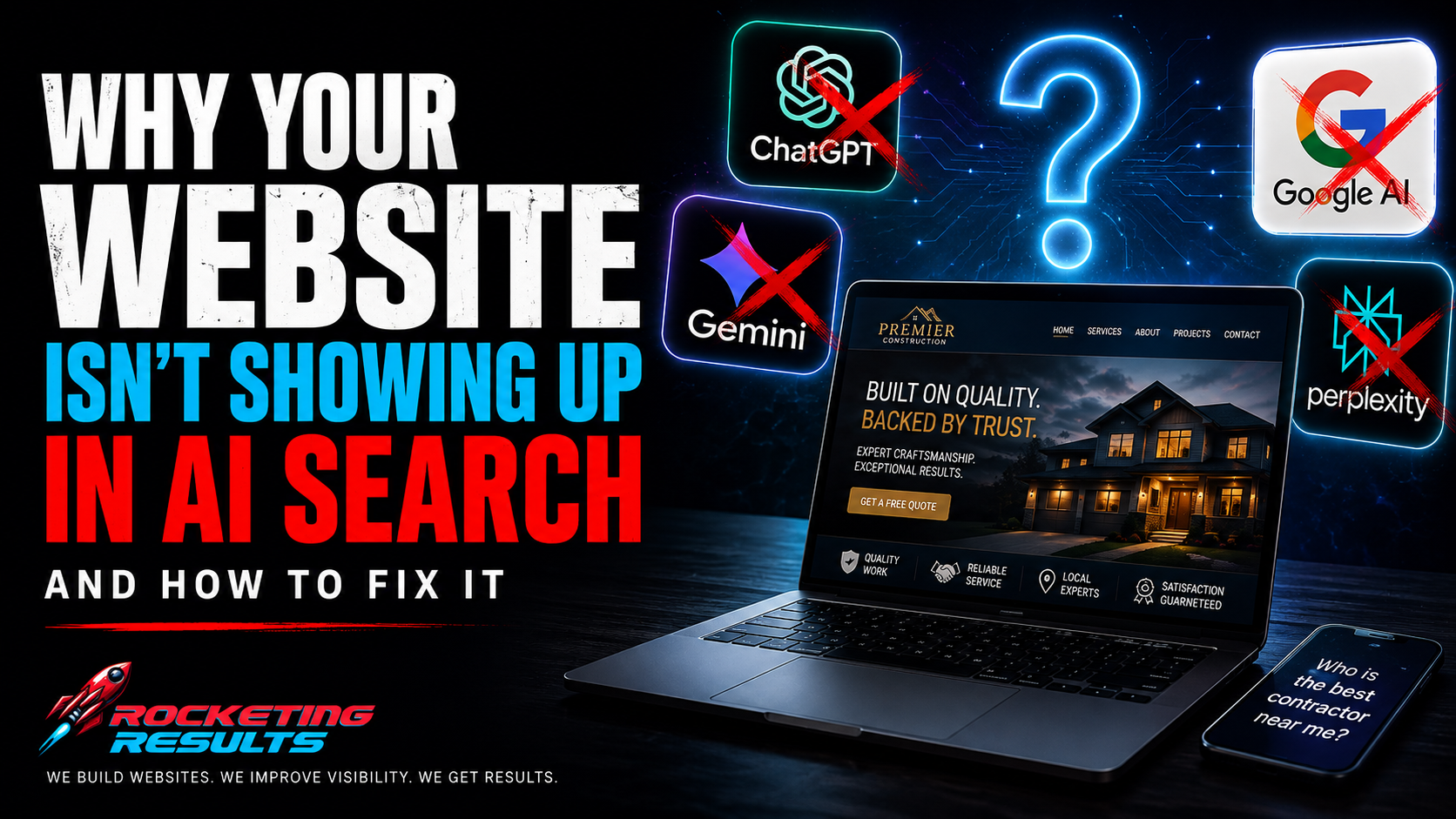
You invested in a professional website.
It loads quickly.
It looks modern.
Your branding is on point.
So why isn’t your business appearing when someone asks ChatGPT, Gemini, Google AI, or Perplexity for recommendations?
The answer surprises many business owners.
A beautiful website does not automatically make your business understandable to search engines or AI systems.
Today’s AI-powered search tools don’t simply look for attractive websites. They look for evidence that your business is trustworthy, experienced, well documented, and easy to understand.
If those signals are missing, AI may choose to recommend someone else instead.
In this guide, I’ll explain why that happens and what you can do about it.
The Biggest Misconception About AI Search
Many people believe that because AI helped build their website, it’s automatically optimized for AI search.
It isn’t.
Website builders and AI writing tools can produce attractive pages quickly, but they don’t automatically create the signals that Google and AI systems rely on when deciding which businesses to recommend.
Those signals still need to be built intentionally.
How AI Search Actually Works
When someone asks:
“Who is the best electrician near me?”
or
“Recommend a roofing company in Tampa.”
AI systems evaluate far more than keywords.
They look for consistent information across many trusted sources and try to determine:
• Does this business actually exist?
• Is it legitimate?
• Is the information consistent?
• Is there evidence of real experience?
• Is this business mentioned elsewhere online?
• Are customers talking about it?
• Does the website clearly explain what the business does?
• Is the content helpful?
• Is the business an authority on its subject?
The businesses with the strongest overall trust signals are more likely to appear.
EEAT Matters More Than Ever
Google has spent years emphasizing EEAT.
EEAT stands for:
Experience
Does the content demonstrate real-world experience?
Can visitors tell you’ve actually done the work?
Real photos, completed projects, customer stories, and practical insights all help.
Expertise
Do you actually know what you’re talking about?
Helpful content that answers real customer questions demonstrates expertise far better than generic marketing copy.
Authoritativeness
Are other trusted sources recognizing your business?
Examples include:
- Quality backlinks
- Industry organizations
- Local citations
- Media mentions
- Professional associations
- Positive reviews
Trustworthiness
Trust is built through consistency.
Customers and search engines expect to find the same business name, address, phone number, website, services, and business details wherever they look.
Your Website Isn’t the Only Thing AI Reads
One of the biggest mistakes business owners make is assuming AI only reads their website.
It doesn’t.
AI may evaluate information from:
- Your Google Business Profile
- Business directories
- Industry websites
- Reviews
- Local citations
- Social profiles
- Press mentions
- Government records
- Professional organizations
- News articles
- Your own blog
- Frequently asked questions
The stronger and more consistent those signals are, the easier it becomes for AI to understand your business.
Common Reasons AI Doesn’t Recommend Your Business
Your website doesn’t clearly explain what you do.
Avoid clever headlines that never mention your services.
Instead of:
“We Build Dreams.”
Use:
“Custom Home Builder Serving Tampa, Florida.”
Your Google Business Profile isn’t fully optimized.
An incomplete profile creates missing trust signals.
Photos, services, categories, reviews, business descriptions, products, updates, and questions all contribute.
Your content is too generic.
Many websites say:
“We provide excellent customer service.”
Thousands of businesses say that.
Instead, explain your actual process.
Answer customer questions.
Share examples.
Teach something useful.
There isn’t enough evidence that you’re an expert.
Publish:
How-to guides
Frequently asked questions
Case studies
Project galleries
Service comparisons
Maintenance tips
Buying guides
Your website lacks structured data.
Schema markup helps search engines understand:
Your business
Services
Reviews
Service areas
Frequently asked questions
Articles
Authors
Organizations
Local business information
What Makes a Website Easier for AI to Understand?
A strong AI-friendly website includes:
✓ Clear service pages
✓ Helpful educational content
✓ Logical internal linking
✓ Fast loading speeds
✓ Mobile-friendly design
✓ Accurate business information
✓ Schema markup
✓ Original photography
✓ Customer reviews
✓ Detailed About page
✓ Clear contact information
✓ Helpful FAQs
✓ Author information
✓ Regular updates
Does Ranking #1 Guarantee AI Recommendations?
No.
Traditional SEO rankings and AI recommendations overlap, but they are not the same.
A business may rank well organically yet receive few mentions in AI-generated answers, while another business with stronger trust signals and clearer topical authority may be cited more often.
The goal is not simply to rank. It is to become a source that search engines and AI systems understand and trust.
Frequently Asked Questions
Can ChatGPT crawl my website?
ChatGPT itself doesn’t continuously crawl the web like a traditional search engine. Depending on how it’s being used, it may rely on indexed web content, licensed data, or live search features. Making your website easy for search engines to understand increases the likelihood that AI-powered tools can surface accurate information about your business.
Does AI replace SEO?
No.
SEO remains the foundation.
AI search builds on many of the same signals, including technical quality, helpful content, authority, and trust.
Can I optimize specifically for ChatGPT?
Not directly.
There is no official “ChatGPT optimization” checklist. The most effective approach is to create accurate, well-structured, authoritative content and maintain a strong overall web presence.
How long does it take?
Improving AI visibility is an ongoing process. Depending on your website, competition, and current authority, meaningful improvements may take weeks or months rather than days.
Final Thoughts
AI search is changing how people discover local businesses, but the fundamentals haven’t disappeared.
Businesses that consistently demonstrate experience, expertise, authority, and trust are in the strongest position to be found, whether someone searches on Google, asks ChatGPT for a recommendation, or uses another AI-powered search tool.
If your website looks great but isn’t generating the visibility or leads you expected, the issue may not be the design. It may be that search engines and AI systems don’t yet have enough information to confidently understand and recommend your business.
At Rocketing Results, I help businesses build websites and local SEO strategies that make it easier for both people and search engines to understand who they are, what they do, and why they deserve to be found.
If you’re not sure where your website stands, I’d be happy to review it and identify opportunities to improve its visibility.